Books Recommended by James Stanley
Read the interview: James Stanley
6 books recommended by James Stanley

How to Win Friends and Influence People
Favourite business-related book is "How to Win Friends and Influence People" by Dale Carnegie. When I got my first internship the boss recommended it to me, and I didn't read it for ages because the title sounded a bit manipulative. But the content is not… Read the full quote
Favourite business-related book is "How to Win Friends and Influence People" by Dale Carnegie. When I got my first internship the boss recommended it to me, and I didn't read it for ages because the title sounded a bit manipulative. But the content is not about manipulating people at all, it's about how to be a better person. Lots of good advice, although I don't apply it as well as I should. I get lots out of it each time I re-read it.

Zen and the Art of Motorcycle Maintenance: An Inquiry into Values
I read it a few years later and found it to be a profoundly interesting book. I ride and maintain motorcycles myself, and the book was spot on about motorcycle maintenance. The book follows a motorcycle journey taken by Pirsig and his son, and talks… Read the full quote
I read it a few years later and found it to be a profoundly interesting book. I ride and maintain motorcycles myself, and the book was spot on about motorcycle maintenance. The book follows a motorcycle journey taken by Pirsig and his son, and talks about philosophy interspersed with anecdotes from the trip. It talks about how, on its surface, any motorcycle maintenance task is just a series of defined steps that must be carried out in order, but when you actually get down to it, you can do any of the individual steps well or not well depending on how good you are or how hard you're trying, etc. There's a lot of thinking about the concept of "Quality" and how doing a Quality job of something is satisfying and admirable in its own right, and how this can be applied to every aspect of life. Gets a bit weird towards the end, but I got a lot out of thinking about that concept of Quality.
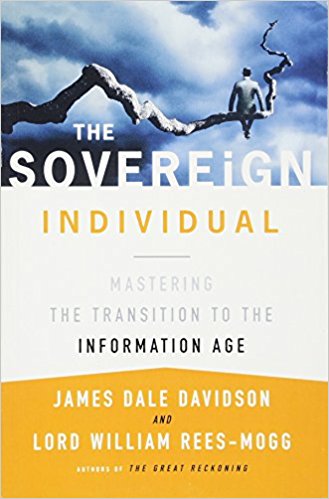
The Sovereign Individual: Mastering the Transition to the Information Age
by James Dale Davidson, William Rees-Mogg
Favourite non-business book is "The Sovereign Individual" by James Dale Davision and William Rees-Mogg. Written in 1996, there's a page in it that predicts the rise of what they call "cybermoney" (but what we now know as "cryptocurrency") in affording individuals freedom over their money… Read the full quote
Favourite non-business book is "The Sovereign Individual" by James Dale Davision and William Rees-Mogg. Written in 1996, there's a page in it that predicts the rise of what they call "cybermoney" (but what we now know as "cryptocurrency") in affording individuals freedom over their money without being subject to coercion or surveillance by banks, governments, etc. Apart from that, there are lots of very astute observations and predictions throughout the book. Its either utopian or dystopian depending on your politics :)

Little Brother
"Little Brother" by Cory Doctorow is a dystopian science fiction story about a teenager who ends up on the wrong side of an authoritarian state. I read it while I was a teenager, and it's the first thing that made me realise that authoritarianism isn't… Read the full quote
"Little Brother" by Cory Doctorow is a dystopian science fiction story about a teenager who ends up on the wrong side of an authoritarian state. I read it while I was a teenager, and it's the first thing that made me realise that authoritarianism isn't just something that happens in the past. It can happen in the future too. Looking back on it now, the writing is certainly aimed at a younger audience, but I enjoyed it very much at the time.

Programming Pearls
by Jon Bentley
I very much enjoyed reading "Programming Pearls" by John Bentley. Most of the software we write is trying to solve fairly large and ill-defined problems in a way that minimises development cost, but Programming Pearls presents a lot of small, well-defined problems, and talks through… Read the full quote
I very much enjoyed reading "Programming Pearls" by John Bentley. Most of the software we write is trying to solve fairly large and ill-defined problems in a way that minimises development cost, but Programming Pearls presents a lot of small, well-defined problems, and talks through their solutions in ways that minimise machine resource usage. There are lots of good "a-ha" moments when reading it, and working through ways to think about the problems that knock asymptotic orders off the computational complexity.

The Cuckoo’s Egg: Tracking a Spy Through the Maze of Computer Espionage
by Cliff Stoll
"The Cuckoo's Egg" by Clifford Stoll is another great book. I believe it's the first documented account of a computer being misused by a remote attacker. It talks about how Clifford attached physical teleprinters to the incoming phone lines so that he could see what… Read the full quote
"The Cuckoo's Egg" by Clifford Stoll is another great book. I believe it's the first documented account of a computer being misused by a remote attacker. It talks about how Clifford attached physical teleprinters to the incoming phone lines so that he could see what the attacker was actually doing on the computer, and how he traced the attacker across several countries.