Books Recommended by Charlie Munger
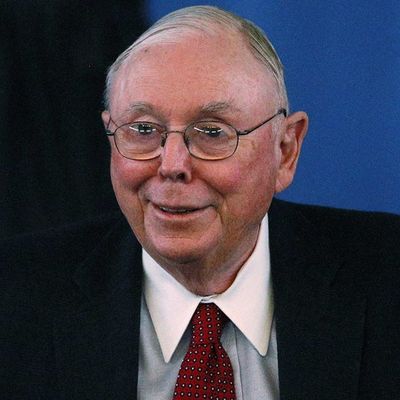 Behind Berkshire Hathaway, one of the largest companies in the world by market value, there is the greatest investment duo: Warren Buffett and his ‘silent’ right hand, Charlie Munger. They’ve been friends and business partners for 60 years. Together they run the Omaha, Nebraska-based holding company, that works as an “umbrella” for other smaller companies and is publicly traded.
Munger grew up during the ‘30s Great Depression, when he helped his family by working to earn his own money. During the Second World War, he started to major in mathematics but, as there was a high demand for military service, enlisted in the Army Air Corps during his second college year. He was sent to study general science and engineering, and afterwards trained to become a meteorologist – then essential to flyers. After being discharged from the Army Air Corps at the end of the war, he graduated from Harvard Law School with magna cum laude.
He started practicing law at a firm in Southern California, while turning to outside ventures and investing. In 1962, Munger established a new law firm together with four colleagues and, over the years, it became one of the nation’s leading business law firms. Charlie left the firm as an active partner a few years later, to focus on investment partnerships.
He met Warren Buffett in 1959, at a homecoming dinner held by a family friend, and they’ve kept up through frequent telephone conversations and letters. In time, their independent portfolios started to have overlapping investments. They both invested in a company that was acquired by Berkshire Hathaway, and their shares were converted into Berkshire Hathaway stock – that’s when they decided they no longer want to manage funds directly for investors and started to build equity through stock ownership in the holding company.
Munger has a unique worldview, a self-developed ‘Multiple Mental Models’ approach that borrows big ideas from a variety of disciplines and serves as his framework for gathering, processing and acting on information. He’s self-taught and considers that the patient, organized and focused approach to life helped him become a successful investor.
He’s also eager to identify and acknowledge his own mistakes and learn from them, as he once said: “If Berkshire has made a modest progress, a good deal of it is because Warren and I are very good at destroying our own best-loved ideas. Any year that you don’t destroy one of your best-loved ideas is probably a wasted year.”
Munger spends most of his days reading, learning and thinking, rather than doing – he doesn’t make a lot of investments. He attributes a great deal of his success to reading and said that:
“In my whole life, I have known no wise people (over a broad subject matter area) who didn’t read all the time. You’d be amazed how much Warren reads – and how much I read. My children laugh at me. They say I’m a book with a couple of legs sticking out.”
Charlie is also a philanthropist and frequently donates millions of dollars to educational and research institutions.
If you want to learn more about Charlie Munger, his approach to learning, decision making, mental models, investing and more, the best read is “Charlie’s Almanack”, a book edited by Peter Kaufman and with a foreword by Warren Buffett. The proceeds from the sales are donated to the Munger Research Center of the Huntington Library.
Books recommended by Charlie Munger:
Reading lists by year: 2023
Books by Charlie Munger
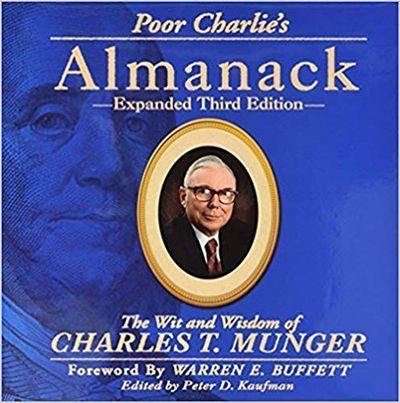
31 books recommended by Charlie Munger

Influence: The Psychology of Persuasion
Robert Cialdini has had a greater impact on my thinking on this topic than any other scientist.

Guns, Germs, and Steel: The Fates of Human Societies
I have recently read a new book twice, which I very seldom do. And that book is "Guns, Germs and Steel" by Jared Diamond. And it's a marvelous book. And the way the guy's mind works would be useful in business.

Only the Paranoid Survive: How to Exploit the Crisis Points That Challenge Every Company
In my whole life, I have known no wise people (over a broad subject matter area) who didn't read all the time -- none, zero. You'd be amazed at how much Warren reads -- and at how much I read. My children laugh at me. They think I'm a book with a couple of legs sticking out.

Getting to Yes: Negotiating Agreement Without Giving In
Charlie Munger recommends this title in the book "Poor Charlie's Almanack: The Wit and Wisdom of Charles T. Munger".
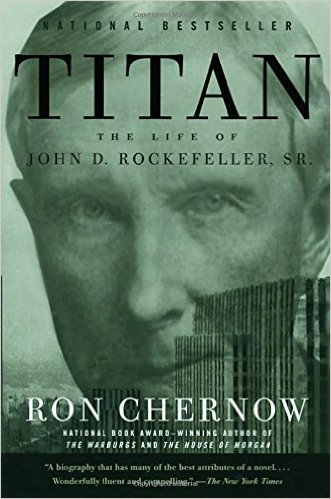
Titan: The Life of John D. Rockefeller Sr.
by Ron Chernow
Another book that I liked very much this year was "Titan", the biography of the original John D. Rockefeller. That's one of the best business biographies I have ever read.

Genome: The Autobiography of a Species in 23 Chapters
by Matt Ridley
And the figures that Ridley quotes are awesomely interesting. It is a fabulous book.

Mastering the Market Cycle: Getting the Odds on Your Side
by Howard Marks
I always say, ‘There’s no better teacher than history in determining the future.’ Howard’s book tells us how to learn from history . . . and thus get a better idea of what the future holds.
Yes!: 50 Scientifically Proven Ways to Be Persuasive
by Noah J. Goldstein, Steve J. Martin, Robert B. Cialdini
And he's just got a new book that's coming out and for sale in Omaha today, I think, for the first time, and that's called "Yes." So here's two books that I suggest you add to your class.
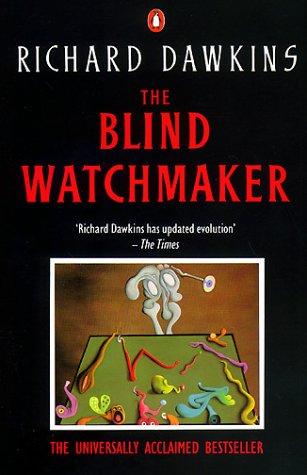
The Blind Watchmaker
And I — if you take [evolutionary biologist Richard] Dawkins, "The Selfish Gene" and "The Blind Watchmaker", I mean, these are marvelous books. And there are words in those books that are entering the English language that are going to be in the next Oxford Dictionary. I mean, these are powerful books.

The Selfish Gene
Charlie Munger recommends this book in the second edition of Poor Charlie’s Almanack.

A Matter of Degrees: What Temperature Reveals about the Past and Future of Our Species, Planet, and Universe
by Gino Segre
In my whole life, I have known no wise people (over a broad subject matter area) who didn't read all the time—none. Zero. You'd be amazed at how much Warren reads—and how much I read. My children laugh at me. They think I'm a book with a couple of legs sticking out.

Andrew Carnegie
by David Nasaw
The definitive biography of an industrial genius, philanthropist, and enigma. At the meeting in May of this year, Munger also mentioned the Mellon Brothers as people to study.

Deep Simplicity: Bringing Order to Chaos and Complexity
by John Gribbin
… it's pretty hard to understand everything, but if you can't understand it, you can always give it to a more intelligent friend.

Faraday, Maxwell, and the Electromagnetic Field: How Two Men Revolutionized Physics
It's a combination of scientific biography and explanation of the physics, particularly relating to electricity. It's just the best book of its kind I have ever read, and I just hugely enjoyed it. Couldn't put it down. It was a fabulous human achievement. And neither of the writers is a physicist.

Fiasco: The Inside Story of a Wall Street Trader
I remember reading this shocking book and thinking, holy shit. This book will make you sick.
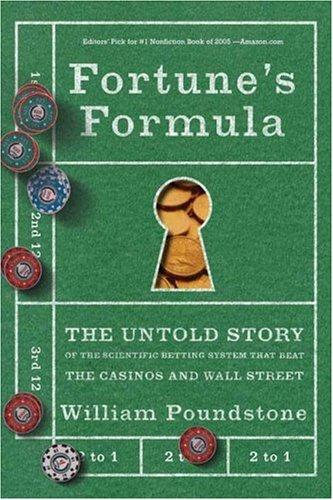
Fortune’s Formula: The Untold Story of the Scientific Betting System That Beat the Casinos and Wall Street
William Poundstone's book Fortune's Formula collects much of the modern evidence on this point in a highly entertaining way.

How The Scots Invented the Modern World: The True Story of How Western Europe’s Poorest Nation Created Our World & Everything in It
A lot of really important stuff like: the first modern nation, the first literate society, the ideas for (modern) democracy and free markets, all originated with the Scots.

Ice Age: How a Change of Climate Made Us Human
(The) best work of science exposition and history that I've read in many years!
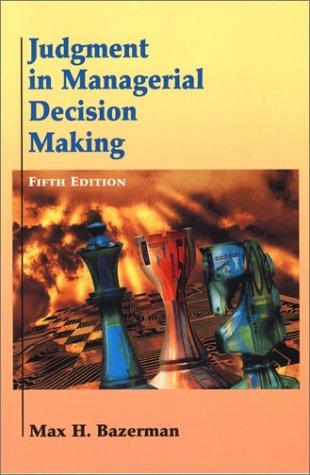
Judgment in Managerial Decision Making
There's a textbook which is called, I think, "Judgment in Managerial Decision Making." And it's used in some of the business schools, and it's actually quite a good book.
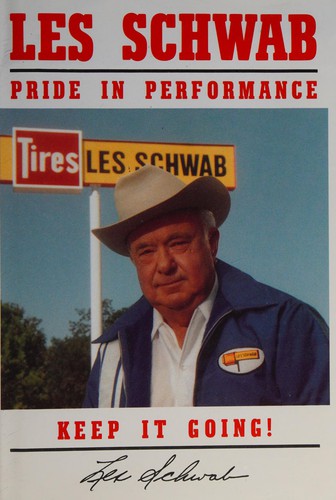
Les Schwab: Pride in Performance, Keep It Going!
by Les Schwab
Yeah, if you want to read one book that will demonstrate really shrewd compensation systems in a whole chain of small businesses, read the autobiography of Les Schwab, who had a bunch of tire shops — has a bunch of tire shops — all over the Northwest.

Living within Limits: Ecology, Economics, and Population Taboos
It is a summary of the major things Hardin has learned in a lifetime. He is a real thinker. That is a fabulous book [...] I advise you to read it twice (which I did)... because it is the condensed wisdom of a very smart man.

Models of My Life
An autobiography of Nobel laureate Herbert A. Simon, a remarkable polymath who more people should know about. In an age of increasing specialization, he’s a rare generalist — applying what he learned as a scientist to other aspects of his life. Crossing disciplines, he was… Read the full quote
An autobiography of Nobel laureate Herbert A. Simon, a remarkable polymath who more people should know about. In an age of increasing specialization, he’s a rare generalist — applying what he learned as a scientist to other aspects of his life. Crossing disciplines, he was at the intersection of “information sciences.” He won the Nobel for his theory of “bounded rationality,” and is perhaps best known for his insightful quote “A wealth of information creates a poverty of attention.”
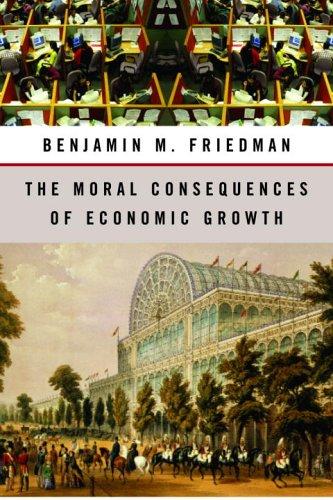
The Moral Consequences of Economic Growth
Since the talk was given, I came across a book published by Alfred A. Knopf in 2005. It was written by a distinguished Harvard economics professor, Benjamin M. Friedman, and dealt with the interplay of economics and morals, much as I wished to in my talk.
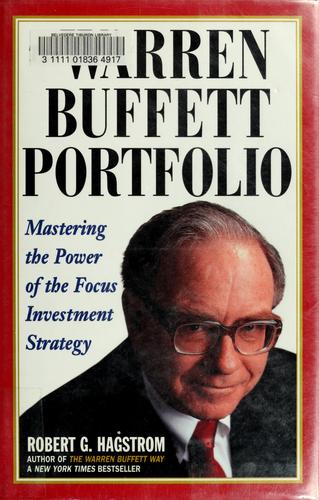
The Warren Buffett Portfolio: Mastering the Power of the Focus Investment Strategy
I read it and I was flabbergasted to find it not only very well written, but a considerable contribution to the synthesis of human thought on the investment process. And I would recommend that all of you buy a copy of Hagstrom's second Buffett book.
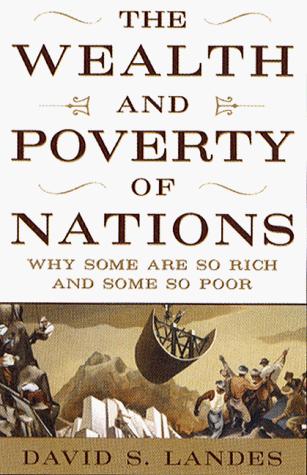
The Wealth and Poverty of Nations: Why Some Are So Rich and Some So Poor
And his book is a takeoff in title on Adam Smith, and the title is, "The Wealth and Poverty of Nations." And the guy's name is [David] Landes. So I would heartily recommend those 3 books.

Three Scientists and Their Gods: Looking for Meaning in an Age of Information
Charlie Munger recommends this title in the book "Poor Charlie's Almanack: The Wit and Wisdom of Charles T. Munger".

Similar reading lists
- Ola Olusoga (3 books in common)