Books Recommended by Anoop Anthony
Read the interview: Anoop Anthony
10 books recommended by Anoop Anthony

The War of Art: Break Through the Blocks and Win Your Inner Creative Battles
The book introduces, among other things, the idea of 'Resistance', an oppositional force at war with human endeavor and ingenuity, a kind of near-demonic energy that 'resists' creative yield. Now, I know that sounds like 'new age' baloney and semi-spiritual psychobabble, but the War of… Read the full quote
The book introduces, among other things, the idea of 'Resistance', an oppositional force at war with human endeavor and ingenuity, a kind of near-demonic energy that 'resists' creative yield. Now, I know that sounds like 'new age' baloney and semi-spiritual psychobabble, but the War of Art is anything but vague and whimsical. It is a hard-hitting, take-no-prisoners treatise on the universal challenge of creation. It is tremendously, gloriously encouraging — it illustrates how the struggle to create, to grow, to seek discipline and rigor and progress, are fundamentally human challenges. It shines a light into the darkness of creative dearth; it puts into words the unspoken struggles of millions of artists. It was first published in 2002, and you only have to read its testimonies to understand its impact.
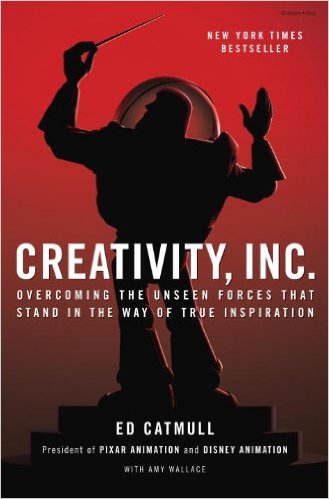
Creativity, Inc.: Overcoming the Unseen Forces That Stand in the Way of True Inspiration
Creativity Inc, narrated by Pixar's co-founder Ed Catmull, documents the meteoric rise of Pixar from its humble roots as a technology company to the movie studio powerhouse it is today. The book offers a treasure of insights to anyone running a business that involves creative… Read the full quote
Creativity Inc, narrated by Pixar's co-founder Ed Catmull, documents the meteoric rise of Pixar from its humble roots as a technology company to the movie studio powerhouse it is today. The book offers a treasure of insights to anyone running a business that involves creative production of any kind. Ed talks about crucial strategies used by Pixar — the idea that every person in an organization is accountable for quality, that creative freedom and exploration are instrumental to building great products, that failure early in the process is not just acceptable but also to be encouraged, and many others.

Don’t Make Me Think: A Common Sense Approach to Web Usability
by Steve Krug
Krug was teaching usability two decades ago when UX wasn't a buzzword, and the WWW was still in its nascent stages. (The first edition of this book was published in 2000!) I cut my teeth on Don't make me think back when I first started… Read the full quote
Krug was teaching usability two decades ago when UX wasn't a buzzword, and the WWW was still in its nascent stages. (The first edition of this book was published in 2000!) I cut my teeth on Don't make me think back when I first started out in the industry. It is now in its third edition and still relevant — it offers compelling insights into building great user experiences into websites and applications.

Getting Real
by Jason Fried, David Heinemeier Hansson, Matthew Linderman
Written by the creators of Basecamp (formerly 37 signals), it is refreshingly bull-shit free for a business book. Each chapter is bite-sized — a little nugget of wisdom — usually a paragraph or two and often bracingly insightful. The book addresses the practical challenges of… Read the full quote
Written by the creators of Basecamp (formerly 37 signals), it is refreshingly bull-shit free for a business book. Each chapter is bite-sized — a little nugget of wisdom — usually a paragraph or two and often bracingly insightful. The book addresses the practical challenges of running and growing a product-based software company, and the advice is sometimes terse and brutal. (see 'Start with No", "Have an Enemy", "Always hire a writer," etc.). First published in 2006, Getting Real espoused a fiercely opinionated, common-sense approach to building a software company, rejecting traditional business tropes, offering a new paradigm for a new kind of business. Not only did Fried and Hansson practice what they preached, they were successful too. I'd still recommend this to a young software entrepreneur getting into the crowded technology space today.

The Right Stuff
by Tom Wolfe
The Right Stuff is a marvelously readable book about test pilots and astronauts.

Endurance: A Year in Space, A Lifetime of Discovery
by Scott Kelly
Reading Endurance puts things in perspective; some of us have callings with remarkable purpose — the very future of humankind — at significant risk to one's own life and creature comforts. It may sound corny, but it makes one wonder: can the work we do in our industries and businesses have a higher purpose than just commercial success?

Blood, Sweat, and Pixels: The Triumphant, Turbulent Stories Behind How Video Games Are Made
A journalistic masterpiece about the grueling production journeys of some of today's most successful video games. Having worked in video game development for about three years, I know that making video games is one of the hardest jobs in the world. Video games are fun… Read the full quote
A journalistic masterpiece about the grueling production journeys of some of today's most successful video games. Having worked in video game development for about three years, I know that making video games is one of the hardest jobs in the world. Video games are fun when you play them, but creating AAA titles involves long hard hours, vast budgets, and herculean team efforts. Video game production brings together disparate creative disciplines like no other industry — Coding, AI, Graphics, Music, Sound, Storytelling & Narrative.

Mere Christianity
by C. S. Lewis
"Mere Christianity" is first and foremost a rational book — it is in many ways the opposite of a traditional religious tome. Lewis, who was once an atheist, has been on both sides of the table, and he approaches the notion of God with accessible,… Read the full quote
"Mere Christianity" is first and foremost a rational book — it is in many ways the opposite of a traditional religious tome. Lewis, who was once an atheist, has been on both sides of the table, and he approaches the notion of God with accessible, clear thinking. The book reveals that experiencing God doesn't have to be a mystical exercise; God can be a concrete and logical conclusion. Lewis was a man of formidable intellect, and he brought it all to bear in this phenomenal book on the rationality of faith.

Mini Habits: Smaller Habits, Bigger Results
I would say it was Stephen Guise's book "Mini Habits: Smaller Habits, Bigger Results." The title sounds like one of those formulaic self-help books, of which there are hundreds. But this one's different. Guise has derived a somewhat counter-intuitive approach to building habits and tackling… Read the full quote
I would say it was Stephen Guise's book "Mini Habits: Smaller Habits, Bigger Results." The title sounds like one of those formulaic self-help books, of which there are hundreds. But this one's different. Guise has derived a somewhat counter-intuitive approach to building habits and tackling hard projects. He suggests that we fail in bringing about personal change because we set the bar too high. He proposes an alternate approach that at first sounds a little weird — build 'mini-habits', (ludicrously) microscopic versions of the habits or projects you want to adopt. He dwells deep into the psychological advantage of this technique, revealing why we fail and why the idea of 'mini-habits' practically guarantees success.
I'm usually averse to self-help books that espouse trite productivity formulas; I avoid them like the plague. But this one came highly recommended, and to my surprise, the technique worked!

Temporary People
I read Temporary People by Deepak Unnikrishnan, a magic realism masterpiece about expatriates and Indian diaspora in the Middle East.