David Heinemeier Hansson’s 2017 Reading List
The 12 books David Heinemeier Hansson recommended in 2017, with the reasons in their own words. See all the books David Heinemeier Hansson recommends.
Other years: 2018
12 books recommended in 2017

The Richest Man in Babylon
This is a 1920s classic version of How To Get Rich. The ancestor of all the pale imitations, like Rich Dad/Poor Dad, that came since. And while I scoffed at plenty of the allegories from ancient Babylon that presents the lessons, it was still a… Read the full quote
This is a 1920s classic version of How To Get Rich. The ancestor of all the pale imitations, like Rich Dad/Poor Dad, that came since. And while I scoffed at plenty of the allegories from ancient Babylon that presents the lessons, it was still a neat package. And at least ancient Babylon is a more interesting backdrop for teaching lessons about money than some suburban house flipper. I ended up liking it more at the end than I did at the beginning. It’s also a really interesting tie-in with that debt history book.

The Republic
by Plato
I’m about a third through this and still can’t tell whether Plato is making a mockery of Socrates ideas for the idyllic society or not. So many of the arguments presented as Socrates’ are so tortured and with so disconnected leaps of logic that it’s… Read the full quote
I’m about a third through this and still can’t tell whether Plato is making a mockery of Socrates ideas for the idyllic society or not. So many of the arguments presented as Socrates’ are so tortured and with so disconnected leaps of logic that it’s hard to take it at face value. Yet still, it’s good fun to follow the dialogue. It reads more like a play than a book, and again, immensely accessible. It’s fun to see the lines that continue from a book like this to the considerations of the Stoics all the way to Adam Smith and the Wealth of Nations and then onto a modern critique and history in that Debt: First 5,000 Years. A conversation spanning millennia.

The Wealth of Nations
by Adam Smith
It’s hard to believe that Adam Smith wrote this tome in 1776! It’s written in such plain, if repetitive, language that it makes the basic economic theory easily accessible. That doesn’t mean it’s right. The book on Debt: The First 5,000 Years spent a fair… Read the full quote
It’s hard to believe that Adam Smith wrote this tome in 1776! It’s written in such plain, if repetitive, language that it makes the basic economic theory easily accessible. That doesn’t mean it’s right. The book on Debt: The First 5,000 Years spent a fair chunk of time debunking many of Smith’s accounts of “the barter, truck, and exchange” cultures that supposedly were the rude state of man before the introduction of coinage. But the book is all the better from a read with a critical mind. It presents such a basic, plain description of capitalism and its functions that serves as a proper grounding for a critique. It’s also full of kinda hilarious deep dives into the exchange rates between silver and gold and other commodities set to 1770s prices.

The Life-Changing Magic of Tidying
by Marie Kondo
On a lighter note, I finished The Life-Changing Magic of Tidying Up: The Japanese Art of Decluttering and Organizing by Marie Kondo. It’s a short book, but it still manages to repeat itself a lot. And yet the core patterns it covers are as effective… Read the full quote
On a lighter note, I finished The Life-Changing Magic of Tidying Up: The Japanese Art of Decluttering and Organizing by Marie Kondo. It’s a short book, but it still manages to repeat itself a lot. And yet the core patterns it covers are as effective as they are simple. I’ve been on a decluttering kick at home and feel so much better because of it. It was also the kickstarter for the conversation with JF that lead us to sell WWR.

The Undoing Project: A Friendship That Changed Our Minds
Michael Lewis is just a great storyteller, and tell a story in this he does. It’s about two Israeli psychologists, their collaboration on the irrationality of the human mind, and the milestones they set with concepts like loss-aversion, endowment effect, and other common quirks that… Read the full quote
Michael Lewis is just a great storyteller, and tell a story in this he does. It’s about two Israeli psychologists, their collaboration on the irrationality of the human mind, and the milestones they set with concepts like loss-aversion, endowment effect, and other common quirks that the assumption of rationality doesn’t account for. It’s a bit long-winded, but if you like Lewis’ style, you probably won’t mind it. The scientific recaps could have happened in a book 1/10th the length, but then you’d miss out on the character portrayals of these two fascinating scientists.

Antifragile: Things That Gain from Disorder
Ryan recommended this earlier, and I had already read Black Swan, so followed up here. I’m of two minds with this book so far. On the one hand, I think Nassim does a great job at taking swings at The Establishment thinking in economics in… Read the full quote
Ryan recommended this earlier, and I had already read Black Swan, so followed up here. I’m of two minds with this book so far. On the one hand, I think Nassim does a great job at taking swings at The Establishment thinking in economics in particular, but on the other hand the tone at times seem needlessly polemic. The irony of me saying that of all people is not lost. Which is perhaps the best take-away from the book so far: That it’s a mirror on how to present arguments in a compelling, believable, punchy fashion, without getting lost swinging at ghosts and straw men.

The New Tsar: The Rise and Reign of Vladimir Putin
With Russia fever at Defcon 2, I’ve made it about half-ways through the biography The New Tsar: The Rise and Reign of Vladimir Putin. It’s a great refresher on post-WWII history, the cold war, KGB, but above all, on the forces present in Russia. There… Read the full quote
With Russia fever at Defcon 2, I’ve made it about half-ways through the biography The New Tsar: The Rise and Reign of Vladimir Putin. It’s a great refresher on post-WWII history, the cold war, KGB, but above all, on the forces present in Russia.
There are many lines to draw between Russia’s struggles after the fall of Communism with the fundamental political theories of Fukuyama (Origins of Political Order / Political Order And Political Decay). When taken together, they lend an all the more human and sympathetic story to why things played out the way they did. While still appreciating just how immense the level of brokenness, corruption, and brutality that journey has brought with it.

The Stranger
by Albert Camus
Seminal novel on existentialism and the absurd by Albert Camus from 1946. Explores that feeling of disconnectedness from society, its norms, and the absurdity of every day life. Striking first-person account in a powerful, direct language.

The Myth of Sisyphus and Other Essays
by Albert Camus
Camus’ philosophical exposition of absurdity, suicide in the face of meaninglessness, and other cherry topics that continue on from his fictional work in novels like The Stranger. It’s surprisingly readable, unlike many other mid 20th century philosophers, yet no less deep or pointy. It’s a… Read the full quote
Camus’ philosophical exposition of absurdity, suicide in the face of meaninglessness, and other cherry topics that continue on from his fictional work in novels like The Stranger. It’s surprisingly readable, unlike many other mid 20th century philosophers, yet no less deep or pointy. It’s a great follow-up, as an original text, to that book The Age of Absurdity, I recommended last year. Still working through it.

Debt: The first 5,000 Years
After a few false starts, I finally got going with this, and what a treat. It shoots down the common myth that prior to money, everyone just bartered shit. I give you a pig, you give me five pies and a hat. Evidence shows that… Read the full quote
After a few false starts, I finally got going with this, and what a treat. It shoots down the common myth that prior to money, everyone just bartered shit. I give you a pig, you give me five pies and a hat. Evidence shows that just wasn’t at all how things went. Most societies were structured either rather communistic (take what you need, give what you can) or with a loose debt-ledger system (or a combination of both). But where things get really interesting is how the emergence of market economies (and money) changed the relationship with human life and dignity. Especially as a consequence of slavery, which put a very explicit price on that which previously was priceless. All sorts of fascinating historical links to women wearing veils (to distinguish them from women who could be bought), how debt peonage really took off once slavery came profitable (so debtors could be sold, or their children sold, if they failed to repay), and how other morality got intertwined with debt. It’s truly eye-opening, and the lines trace disturbingly well from millennia.

Political Order and Political Decay: From the Industrial Revolution to the Globalization of Democracy
In the last 10% of Political Order and Political Decay. It’s been about 50 hours of listening between that volume and the first, The Origins of Political Order. So quite the undertaking. But we’ve finally progressed all the way through the history of political order… Read the full quote
In the last 10% of Political Order and Political Decay. It’s been about 50 hours of listening between that volume and the first, The Origins of Political Order. So quite the undertaking. But we’ve finally progressed all the way through the history of political order and arrived at Fukuyama’s diagnosis of modern day societies. It’s a truly epic journey, and one that’s uniquely timely to the current upheaval. “Things are so crazy now” is only something you’d say in the absence of a historical perspective. These books give you just that and then some.
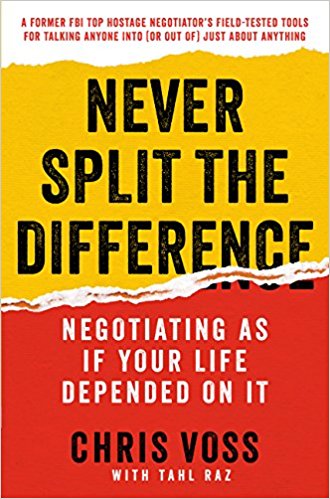
Never Split the Difference: Negotiating As If Your Life Depended On It
by Chris Voss, Tahl Raz
A former FBI hostage negotiator distills the heuristics of how to defuse tense negotiations with unstable humans, and proposes that they’re the same for every other form of negotiations. Not a bad premise, and I found several of the techniques compelling and resonant of what… Read the full quote
A former FBI hostage negotiator distills the heuristics of how to defuse tense negotiations with unstable humans, and proposes that they’re the same for every other form of negotiations. Not a bad premise, and I found several of the techniques compelling and resonant of what I’ve read about human biases and flaws from other sources. But the FBI bravado is grating. It’s basically “hey, I just learned this stuff, and I whattadoknow, I become so bad ass that I could beat every Harvard trained negotiator with my sick mind hacks”. Okay dude. Nassim Taleb would be proud though ?.