Ryan Holiday’s 2016 Reading List
The 20 books Ryan Holiday recommended in 2016, with the reasons in their own words. See all the books Ryan Holiday recommends.
Other years: 2024 · 2018 · 2017 · 2015 · 2014 · 2013 · 2012 · 2011
20 books recommended in 2016
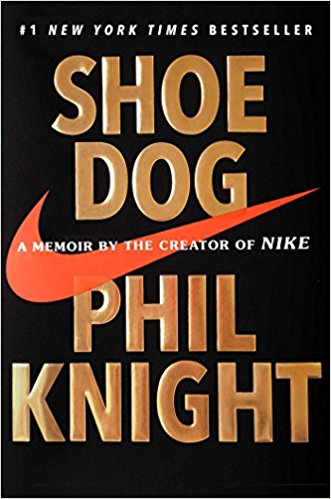
Shoe Dog: A Memoir by the Creator of Nike
by Phil Knight
As a general rule, most new memoirs are mediocre and most business memoirs are even worse. Shoe Dog by Phil Knight is an exception to that rule in every way and as a result, was one of my favorite books of the year and favorite… Read the full quote
As a general rule, most new memoirs are mediocre and most business memoirs are even worse. Shoe Dog by Phil Knight is an exception to that rule in every way and as a result, was one of my favorite books of the year and favorite business books ever. I started reading it while on the runway of a flight and figured I’d read a few pages before opening my laptop and working. Instead, my laptop stayed in my bag during the flight and I read almost the entire book in one extended sitting. Ostensibly the memoir of the founder of Nike, it’s really the story of a lost kid trying to find meaning in his life and it ends with him creating a multi-billion dollar company that changes sports forever. I’m not sure if Knight used a ghostwriter (the acknowledgements are unclear) but his personal touches are all over the book—and the book itself is deeply personal and authentic. The afterward is an incredibly moving reflection of a man looking back on his life. I loved this book. It ends just as Nike is starting to turn into the behemoth it would become, so I hold out hope that there may be more books to follow.

When Breath Becomes Air
Despite its popularity, When Breath Becomes Air is actually underrated. It’s make-you-cry good.

The Last Lion: Winston Spencer Churchill: Defender of the Realm, 1940-1965
by William Manchester, Paul Reid
After the Caro series, I started William Manchester’s equally epic three volume set on Winston Churchill (Visions of Glory, Alone, Defender of the Realm) which Robert Greene gave me as a wedding present last year. Like all truly great long reads, you learn not just… Read the full quote
After the Caro series, I started William Manchester’s equally epic three volume set on Winston Churchill (Visions of Glory, Alone, Defender of the Realm) which Robert Greene gave me as a wedding present last year. Like all truly great long reads, you learn not just about the subject but every intersecting one: the history of British peerage, the Victorian era, the British Empire, Colonialism, modern warfare, international relations, evil, the nature of genius, the effects of absent parents. The book is masterfully written about a masterful man—Churchill was a soldier, a writer, a politician, a statesman, a strategist and a true great man of history. Each book in the series is equally distinct and interesting. The first is Churchill as a young, ambitious man. The second is his time in the political wilderness, when his ego has driven him from power and into writing and thinking. The third is his time back on the world’s stage, in what was perhaps the finest hour of any empire in any era. The last book is probably the best. It features the famous bulldog version of Churchill: rescuing the troops at Dunkirk, persevering through the Blitz, vowing to fight on the landing grounds and the beaches and in the streets, whatever the cost may be. The sheer determination of this man, to take an entire country on your back and defy a horde which had overrun the European continent in a matter of months…it’s almost breathtaking to think about.

Hillbilly Elegy: A Memoir of a Family and Culture in Crisis
by J. D. Vance
In terms of other surprising memoirs, I found JD Vance’s Hillbilly Elegy to be another well-written gem.

The Count of Monte Cristo
I thought I’d read this book before but clearly they gave me some sort of children’s version. Because the one I’d read as a kid wasn’t a 1,200 page epic of some of the most brilliant, beautiful and complicated storytelling ever put to paper. What… Read the full quote
I thought I’d read this book before but clearly they gave me some sort of children’s version. Because the one I’d read as a kid wasn’t a 1,200 page epic of some of the most brilliant, beautiful and complicated storytelling ever put to paper. What a book! When I typed out my notes (and quotes) after finishing this book, it ran some 3,000 words. I was riveted from cover to cover. I enjoyed all the stuff I missed as a kid: the Counts struggle with his faith in light of what was done to him, the Hundred Days of Napoleon’s return, his rants against technology, the criticism of newspapers, the influence of ancient philosophy, ultimately, a warning against being consumed by revenge. Please—if you’re going on a long trip or looking to check out of modern events for a while—get this book. I recommend the Penguin Classics edition.

The Revenant: A Novel of Revenge
Revenge books seemed to be a trend for me this year. I loved Michael Punke’s The Revenant, about a man who bravely challenged his fate in the wilderness just as Edmond Dantes did in prison.

Lancelot
by Walker Percy
This year I also re-read Walker Percy’s Lancelot, a dark story of revenge and an attempt to go to the heart of evil.

Mr. Eternity
by Aaron Thier
Less dark, but equally epic, I also loved (and raved about repeatedly) Aaron Thier’s new novel Mr. Eternity.

The Subtle Art of Not Giving a F*ck: A Counterintuitive Approach to Living a Good Life
by Mark Manson
I loved Mark Manson’s The Subtle Art of Not Giving A Fuck. There’s a reason this book is blowing up. It’s that good.

The World According to Star Wars
Cass Sunstein’s book The World According to Star Wars is another interesting look at the economics of creative work.

It Can’t Happen Here
If you want to be scared about the next four years, pick up Sinclair Lewis’s It Can’t Happen Here (because, well, it may have just happened here).


The Passage of Power: The Years of Lyndon Johnson, Vol. IV
I read my first Robert Caro book, The Power Broker, almost ten years ago. Reading this one--his most recent--on the ascension of Lyndon Johnson reminded me just how much I LOVE really long books (I even ended up writing an article about them). As always,… Read the full quote
I read my first Robert Caro book, The Power Broker, almost ten years ago. Reading this one--his most recent--on the ascension of Lyndon Johnson reminded me just how much I LOVE really long books (I even ended up writing an article about them). As always, Robert Caro is a master of his craft. Despite being some 768 pages, this book flies by and you learn something about history, about human nature, about power on almost every page. I'll be moving on to one of his other Lyndon Johnson books next.

The Song Machine: Inside the Hit Factory
I've been meaning to read this book for a while, and after I did I bought copies for everyone at my company (since we produce books and other kinds of content). In the book, Seabrook explains how just a few men and women are responsible… Read the full quote
I've been meaning to read this book for a while, and after I did I bought copies for everyone at my company (since we produce books and other kinds of content). In the book, Seabrook explains how just a few men and women are responsible for producing nearly every hit song you hear on the radio, see on YouTube or listen to on Spotify. He explains the economics of the music industry in a way that allows you to understand why music is the way that is today (the good parts and the bad parts). As someone who tends to listen to songs on repeat while I write--usually bad songs--it was interesting to hear how many of them were made. My only gripe: He neglects a couple people I would have liked to hear more about like Sia and Linda Perry who are just as prolific as Dr. Luke and Max Martin.

Seneca: Tragedies II: Oedipus, Agamemnon, Thyestes, Hercules on Oeta, Octavia
by Seneca
I'd never read any of Seneca's plays before, which was a big gaping hole in my knowledge. During his lifetime, Seneca was actually more famous for his tragedies than he was for his philosophy (there is a line from one of his plays entombed as… Read the full quote
I'd never read any of Seneca's plays before, which was a big gaping hole in my knowledge. During his lifetime, Seneca was actually more famous for his tragedies than he was for his philosophy (there is a line from one of his plays entombed as graffiti at Pompeii). Anyway, I was enthralled by these dark, disturbing but ultimately stoic plays. My favorite line comes from Hercules: "I do not ask you to show the path; just to give permission, father, I shall find the way." And related to that, my friend Tim Ferriss has released an amazing audiobook edition of Seneca's Letters. You must check them out.

Galveston: A Novel
This a novel from the writer of True Detective (from before he was the guy from True Detective). Guess what? It's really really good. It's a dark noir story (surprise!) but it's got a great character and great lines...even a touching ending. Also, and I… Read the full quote
This a novel from the writer of True Detective (from before he was the guy from True Detective). Guess what? It's really really good. It's a dark noir story (surprise!) but it's got a great character and great lines...even a touching ending. Also, and I know this is pretty controversial, but I think the second season of True Detective was pretty damn good.

The Horse: The Epic History of Our Noble Companion
One of my favorite books I read last year (sneaked in under the wire). The author is so passionate, her history of this magnificent animal is so sweeping and captivating, her language is so beautiful. It's just great. Plus, I learned a lot. For instance,… Read the full quote
One of my favorite books I read last year (sneaked in under the wire). The author is so passionate, her history of this magnificent animal is so sweeping and captivating, her language is so beautiful. It's just great. Plus, I learned a lot. For instance, I had no idea that there is almost no violence depicted in cave paintings (I ended up chatting about it on Ask Historians, one of my favorite places on the internet) or that a lot of archaeologists think that horses originated in North America, migrated to Europe, went extinct here and then traveled back. In this way, horses were our gift to Europe...which they gifted back to us. I wish there'd been a bit more anthrozoology in the book--there's very little discussion of the role of the horse in history over the last 200-300 years (the most interesting part), but perhaps that's for a second book.

Deep Work: Rules for Focused Success in a Distracted World
by Cal Newport
I've been a fan of Cal for a long time. His book So Good They Can't Ignore You is one of my favorites, but it's his new book that's probably had the biggest and most immediate impact on me. For those of you who enjoyed… Read the full quote
I've been a fan of Cal for a long time. His book So Good They Can't Ignore You is one of my favorites, but it's his new book that's probably had the biggest and most immediate impact on me. For those of you who enjoyed Tyler Cowen's Average is Over, you already know how important the ability to focus, be creative, and think at a high level is going to be in the future. This is a book that explains how to cultivate and protect that skill--the ability to do deep work. One thing I've already started doing since reading this book is recording the number of hours of deep work I do each day in my morning journal. It's a way of keeping a running tally and monitoring if I begin to get distracted or slow my pace. Anyway, great book!